
Table of Contents
ToggleFitness Tracker with GPS vs Without GPS: Which One Should You Choose?
Choosing a fitness tracker involves more than comparing prices, designs, and health-monitoring features. One of the most important decisions is whether to buy a fitness tracker with GPS vs without GPS.
GPS can help you monitor outdoor activities, record routes, and measure your distance and pace. However, not everyone needs these features. A fitness tracker without built-in GPS may be more affordable, offer longer battery life, or provide all the essential activity-monitoring functions you need.
So, which option is better?
The answer depends on how you exercise, whether you carry your smartphone, how accurately you want to record outdoor activities, and which features matter most to you.
In this guide, we compare fitness trackers with GPS and without GPS, explain how connected GPS works, examine the advantages and disadvantages of each option, and help you decide which type offers the best value.
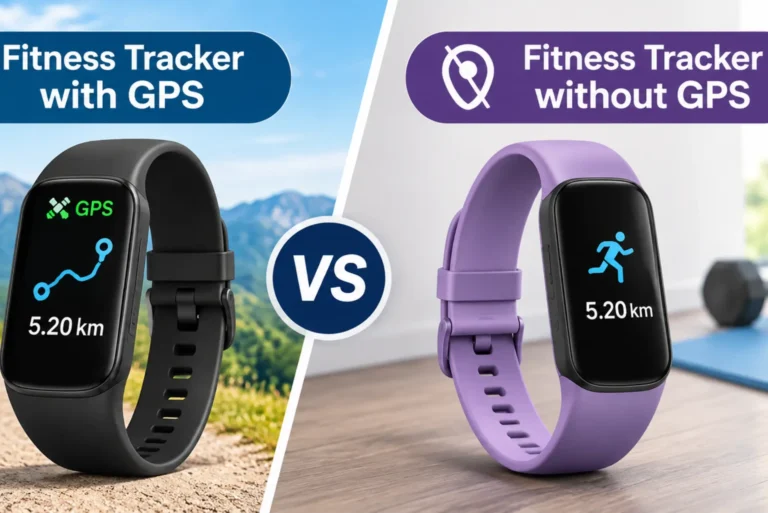
Fitness Tracker with GPS vs Without GPS
A fitness tracker with built-in GPS can record your outdoor route, distance, speed, and pace without relying on your smartphone’s GPS.
A fitness tracker without built-in GPS may still offer GPS tracking through a connected smartphone. Other models do not provide GPS route tracking at all.
Choose a tracker with built-in GPS if you regularly run, cycle, hike, or walk outdoors and prefer leaving your phone behind.
Choose a tracker without built-in GPS if you mainly want to monitor daily activity, steps, sleep, and general workout information, or if you are happy to carry your smartphone during outdoor exercise.
1. What Is a Fitness Tracker with GPS?
A fitness tracker with GPS has a built-in Global Positioning System receiver that communicates with positioning satellites to determine its location.
When you start an outdoor activity, the tracker can use GPS information to record your movement and calculate useful statistics.
Depending on the device, these may include:
Distance travelled.
Running or walking pace.
Speed.
Workout route.
Location and movement information.
Elevation information, where supported by the device’s sensors and software.
For example, when you go for a run, a tracker with built-in GPS can record your route and show how far you travelled. You can then review your workout in the companion mobile app.
Advantages of a Fitness Tracker with GPS
1. Track outdoor routes
Built-in GPS allows you to record where you have walked, run, or cycled. You can review your route after finishing your activity, provided your tracker and its companion software support route mapping.
2. Monitor distance and pace
GPS provides location information that helps calculate outdoor distance and pace. This can be useful when you want more detailed information about your outdoor workouts than step-based distance estimates provide.
3. Exercise without carrying your smartphone
One of the biggest advantages of built-in GPS is independence from your phone’s GPS receiver. You can record a supported outdoor workout without carrying your smartphone.
Check whether your particular tracker can save workout data independently and whether it requires a phone connection for certain features or later synchronisation.
4. Useful for outdoor activities
Built-in GPS can be valuable for walking, running, cycling, hiking, and other activities involving outdoor movement.
5. More detailed workout information
For users who enjoy reviewing their exercise history, GPS route and pace information can provide additional context beyond steps and general activity duration.
Do you prefer a fitness tracker with GPS?
Disadvantages of a Fitness Tracker with GPS
Built-in GPS also comes with a few trade-offs.
Battery consumption: Using built-in GPS can drain the tracker’s battery more quickly than normal daily tracking.
Higher purchase price: Some GPS-equipped models cost more than basic activity trackers, although pricing varies by brand and feature set.
Satellite reception: Tall buildings, heavy tree cover, and other obstructions can make it harder for a tracker to establish or maintain a GPS connection.
Charging frequency: Depending on the model and how often GPS is used, you may need to charge the device more frequently.
The actual battery impact and GPS performance depend on the model, settings, satellite reception, and duration of use.
2. What Is a Fitness Tracker Without GPS?
A fitness tracker without built-in GPS is a device that does not have its own GPS receiver for independent satellite-based location tracking.
However, this does not necessarily mean it cannot record GPS data.
There are two important categories:
Connected GPS: Some trackers without built-in GPS use the GPS receiver in a connected smartphone. The phone must remain nearby, and the necessary app permissions and connection must be available.
No GPS tracking: Other basic trackers do not support GPS route recording at all. They may still measure steps, activity duration, and estimated distance using internal motion sensors.
This distinction is important when comparing devices because a tracker advertised as having connected GPS does not offer exactly the same independence as one with built-in GPS.
Advantages of a Fitness Tracker Without Built-In GPS
1. Often more affordable
Basic fitness trackers without built-in GPS can be less expensive than some GPS-equipped alternatives. They can be suitable for people who want basic activity tracking without paying for features they may not use.
2. Potentially longer battery life
Trackers without built-in GPS do not have to power their own GPS receiver during workouts. This can reduce power consumption, although battery life still depends on other features, including screen technology, notifications, sensors, and usage patterns.
3. Lightweight and comfortable
Many basic activity trackers are designed to be compact and lightweight. This makes them convenient for everyday use.
4. Good for everyday activity monitoring
Depending on the model, a fitness tracker without GPS can still provide useful information such as:
Step counts.
Estimated distance.
Active minutes.
Heart-rate measurements.
Sleep tracking.
General activity summaries.
Workout duration.
5. Connected GPS may be sufficient
If you normally carry your smartphone while walking, running, or cycling, connected GPS may provide the outdoor route and distance information you need without requiring GPS hardware in the tracker itself.
Disadvantages of a Fitness Tracker Without GPS
Phone dependency: Connected GPS requires a compatible smartphone and an active connection.
Less convenient for phone-free workouts: You generally cannot record a connected-GPS route independently of the phone.
Estimated distance may be less precise: Devices without GPS may estimate distance using steps, movement sensors, and stride assumptions.
Limited route information: Models without connected or built-in GPS generally cannot provide a GPS route map of your outdoor workout.
Do you prefer a fitness tracker without GPS instead?
3. Built-In GPS vs Connected GPS vs No GPS: What Is the Difference?
Before purchasing a fitness tracker, it is important to understand the three main GPS configurations.
| Feature | Built-in GPS | Connected GPS | No GPS tracking |
|---|---|---|---|
| GPS receiver in tracker | Yes | No | No |
| Uses smartphone GPS | Not required for standard built-in tracking | Yes | No |
| Records outdoor route | Yes, if supported | Yes, if supported | No |
| Requires phone during workout | Not for GPS recording | Yes | No |
| Tracks outdoor distance | GPS-based | GPS-based through phone | Usually estimated |
| Phone-free GPS workout | Yes | No | No |
| Battery impact on tracker | Can be higher during GPS use | Depends on device and connection | No GPS-related drain |
The most important difference is independence. Built-in GPS allows the tracker to collect satellite positioning information directly. Connected GPS uses the smartphone to supply location information.
For example, Google’s Fitbit support documentation explains that certain Fitbit devices can use built-in GPS, phone-connected GPS, or dynamic GPS, depending on the model. Garmin also describes connected GPS as using a paired smartphone’s GPS and location information.
This means you should always check the exact GPS specification of a device rather than relying solely on its product category.
4. Fitness Tracker with GPS vs Without GPS: Main Differences Explained
Let’s examine the most important buying considerations in more detail.
A. GPS Accuracy
A tracker with built-in GPS can record outdoor location information without depending on your smartphone.
A connected-GPS tracker relies on the smartphone’s GPS receiver, so the quality of the recorded route depends partly on the phone and its ability to maintain the connection.
A tracker without GPS route tracking generally estimates distance using movement and step information.
For users who want detailed outdoor route information, built-in or connected GPS is generally preferable to step-based distance estimation.
B. Battery Life
Battery life is another major factor when choosing between the two options.
GPS tracking requires additional power. Using built-in GPS can therefore shorten the time between charges.
A tracker without built-in GPS may use less power during outdoor activities, particularly when it does not need to maintain a connected-GPS session.
Buying tip: Compare the manufacturer’s estimated battery life in both normal smartwatch or tracker mode and active GPS mode. These figures can be very different.
C. Price
GPS is one of several features that can influence the cost of a fitness tracker.
Some entry-level models offer basic activity and health monitoring without built-in GPS. More advanced models may include GPS, additional sensors, training features, and improved displays.
D. Convenience
Built-in GPS is particularly convenient when you prefer exercising without carrying your smartphone.
Connected GPS offers a middle ground. You can wear a simpler tracker while allowing your phone to handle location recording.
A tracker without any GPS functionality is convenient for daily activity monitoring but is not designed to provide a detailed GPS route.
E. Everyday Health and Activity Monitoring
An important point is that GPS is not necessary for every fitness-tracking feature.
Depending on the device, both GPS and non-GPS trackers may monitor:
Steps.
Heart rate.
Sleep.
Activity duration.
General movement.
Workout sessions.
Notifications.
GPS mainly adds location-related information to supported outdoor activities.
5. Who Should Buy a Fitness Tracker with GPS?
A fitness tracker with built-in GPS may be a suitable choice for people who regularly participate in outdoor activities and want independent route recording.
Consider built-in GPS if you:
Regularly enjoy outdoor running or walking.
Cycle and want to record your routes.
Participate in outdoor hikes.
Prefer not to carry your smartphone during workouts.
Want GPS-based pace and distance information.
Enjoy reviewing route maps and activity history.
The main benefit is convenience. Your tracker can record supported outdoor GPS activities without needing to use your smartphone’s GPS receiver.
6. Who Should Buy a Fitness Tracker Without GPS?
A fitness tracker without built-in GPS may be a practical choice for people who prioritise everyday activity monitoring.
It may be suitable if you:
Mainly want to count your daily steps.
Want to monitor general activity levels.
Are interested in sleep and heart-rate tracking.
Prefer a simple, lightweight device.
Want to spend less on features you may not use.
Normally carry your smartphone during outdoor activities.
A connected-GPS model can also be a good compromise if you want route recording but do not need an independent GPS receiver in the tracker.
7. What Features Should You Consider Before Buying?
GPS should not be the only feature you compare when purchasing a fitness tracker.
Here are some other factors worth considering.
Battery Capacity and Charging
Look at the manufacturer’s battery-life estimates and consider how frequently you will use GPS. A device that lasts several days with basic tracking may have a substantially shorter operating time when GPS is active.
Heart-Rate Monitoring
If you want heart-rate information during everyday activity and exercise, check whether the tracker includes continuous or workout-based heart-rate monitoring.
Sleep Tracking
Some fitness trackers provide sleep-duration estimates and sleep-stage information.
Water Resistance
If you swim or exercise in wet conditions, check the manufacturer’s water-resistance rating and any restrictions.
Smartphone Compatibility
Check whether the tracker works with your Android or iOS smartphone and whether the companion app supports all the features you need.
This is especially important for connected-GPS devices because they depend on smartphone compatibility, permissions, and connectivity.
Display and Comfort
Consider screen readability, strap comfort, weight, and ease of use. A tracker should be comfortable enough for the activities and everyday situations in which you intend to wear it.
App Features and Data Privacy
Check how the companion app displays activity history, exports workout data, manages location permissions, and handles personal information.
8. How to Choose Between a GPS and Non-GPS Fitness Tracker
Use these questions to identify which type best matches your needs.
Question 1: Do you regularly participate in outdoor activities?
If your main activities involve walking, running, hiking, or cycling, GPS can provide useful route and distance information.
Question 2: Do you prefer exercising without your smartphone?
If yes, built-in GPS is worth considering. Connected GPS depends on your phone being available.
Question 3: Are daily activity statistics your main priority?
If you mainly want steps, sleep information, heart-rate readings, and general activity summaries, a basic tracker may be enough.
Question 4: Is battery life particularly important?
Compare the battery specifications carefully. Regular GPS use can reduce operating time, while other features also affect battery consumption.
Question 5: Do you need to see your workout routes?
If reviewing maps and routes is important, choose a model with built-in GPS or connected GPS.
9. Common Questions About Fitness Trackers with GPS vs Without GPS
Does a fitness tracker need GPS to count steps?
No. Fitness trackers can generally count steps using built-in movement sensors, such as accelerometers. GPS is not required for basic step counting.
Can a fitness tracker without GPS measure distance?
Yes. Many trackers estimate distance using recorded steps, movement patterns, and assumed or personalised stride length.
Can I use a fitness tracker with GPS without my phone?
Many built-in-GPS trackers can record supported outdoor activities independently of a smartphone. However, some functions may still require a phone, an internet connection, or the manufacturer’s companion app.
Check the specific model’s offline tracking and synchronisation capabilities before purchasing.
Does GPS drain a fitness tracker’s battery?
Yes. Built-in GPS can increase battery consumption because the tracker needs additional power to receive and process satellite positioning information.
The impact varies by model, GPS settings, satellite reception, and activity duration.
Is connected GPS as good as built-in GPS?
Both can provide GPS-based route information, but they operate differently.
Built-in GPS uses the receiver in the tracker, while connected GPS uses the smartphone’s GPS receiver. Accuracy depends on the individual device, phone, software, and surrounding environment.
Connected GPS also requires the phone to remain available during the activity.
Does GPS work without mobile data?
GPS positioning through satellites generally does not require a mobile data connection. However, some fitness tracker features, such as map downloads, live sharing, weather information, and cloud synchronisation, may require internet access.
The exact requirements depend on the device and its software.
Is a GPS fitness tracker better for walking?
A GPS fitness tracker can be useful if you want to record outdoor walking routes and GPS-based distance information.
If you mainly want to count steps and monitor general activity, a tracker without built-in GPS may be sufficient.
Is a fitness tracker without GPS worth buying?
Yes. A non-GPS tracker can still offer useful activity and health-monitoring features. It can be a sensible choice when route recording is not a priority.
10. Final Verdict: Fitness Tracker with GPS vs Without GPS
When comparing a fitness tracker with GPS vs without GPS, there is no single option that suits everyone.
A tracker with built-in GPS is a strong choice for people who regularly exercise outdoors and want to record routes, distance, and pace without carrying a smartphone.
A tracker without built-in GPS may be better for everyday activity monitoring, particularly when affordability, simplicity, and battery life are priorities. A connected-GPS model is worth considering when you want route recording but usually carry your phone.
The best choice is the one that matches your lifestyle, preferred activities, and budget.
Before making your purchase, compare the exact GPS configuration, battery-life estimates, supported activities, smartphone compatibility, and app features. Understanding these differences will help you choose a fitness tracker that delivers the information you actually need.
Final recommendation: Choose built-in GPS for independent outdoor tracking, connected GPS for phone-assisted route recording, and a non-GPS tracker for straightforward everyday activity monitoring.
Read More Related Articles
That’s it for this article. If you enjoyed reading it, also check out these related guides:
- Fitness Watch for Beginners: Complete Setup and Usage Guide
- How to Choose the Right Fitness Watch for Your Workout Type (Buyer’s Guide)
- How to Extend Your Fitness Watch Battery Life: 10 Proven Tips That Actually Work
- Fitness Watch vs Phone Apps: Which Tracks Better for Health & Fitness?
- How to Sync Smart Watch Apps with Popular Workout Platforms (Complete Guide)