
Table of Contents
ToggleFitness Tracker Sleep Tracking Accuracy: What Does Your Tracker Really Measure?
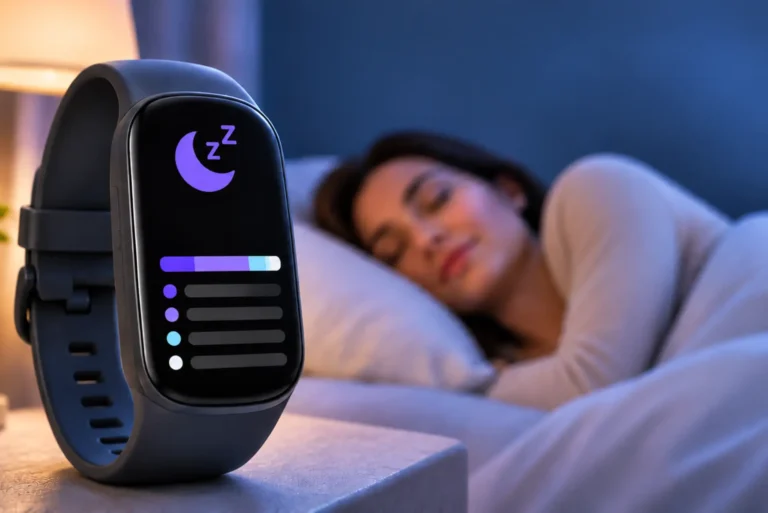
Fitness trackers have made it easier than ever to monitor everyday activity, heart rate and sleep patterns. Many modern wearable devices also provide detailed sleep reports, including estimated sleeping hours, time spent awake, light sleep, deep sleep and rapid eye movement (REM) sleep.
But how reliable are these measurements?
Fitness tracker sleep tracking accuracy is an important consideration when deciding how much confidence to place in the information displayed on a wearable device. Although fitness trackers can provide useful insights into general sleep patterns, their estimates are not always identical to measurements obtained in a professional sleep laboratory.
Understanding how sleep tracking works, what these devices can measure and where their limitations lie can help you interpret your results more sensibly.
In this article, we explore the science behind wearable sleep tracking, examine what research says about its accuracy and explain how to make better use of your sleep data.
How Does a Fitness Tracker Monitor Sleep?
Most wrist-worn fitness trackers do not directly measure sleep in the same way as a clinical sleep study. Instead, they use sensors to collect information about the body and apply software algorithms to estimate when someone is asleep or awake.
Depending on the device, these sensors may include:
1. Accelerometers
Accelerometers detect movement. When a tracker identifies extended periods of reduced movement, its algorithm may interpret this as sleep.
2. Optical Heart Rate Sensors
Many fitness trackers use optical sensors to estimate heart rate by detecting changes in blood flow beneath the skin.
Heart rate patterns can provide additional information about changes in the body’s activity during sleep.
3. Heart Rate Variability (HRV)
Heart rate variability refers to the variation in time between consecutive heartbeats. Some devices use HRV alongside other measurements to help estimate sleep patterns and physiological changes.
4. Skin Temperature Sensors
Some wearable devices measure changes in skin temperature.
5. Breathing-Related Measurements
Certain devices estimate breathing rate using movement or changes in cardiovascular signals. The availability and capabilities of these features vary between manufacturers and models.
By combining available sensor information, proprietary algorithms estimate sleep duration, interruptions and sleep stages.
How Accurate Is Fitness Tracker Sleep Tracking?
The evidence suggests that fitness trackers can be useful for monitoring broad sleep patterns, particularly when used consistently over time.
A 2026 systematic review and meta-analysis examining wearable devices against polysomnography found that wearables tended to overestimate total sleep time and sleep efficiency while underestimating wake after sleep onset. The researchers also reported substantial variation between devices, with no single device consistently outperforming the others across all measurements.
Read the 2026 systematic review and meta-analysis.
A separate 2025 meta-analysis examined 24 studies involving 798 participants and found significant differences between consumer wrist-worn trackers and polysomnography for several sleep measurements.
These findings highlight an important point: a fitness tracker can provide helpful information without necessarily delivering clinically precise measurements.
Read the 2025 consumer wearable meta-analysis.
1. Total Sleep Time
Total sleep time is the estimated amount of time spent sleeping during the night.
For many people, this is one of the most useful measurements provided by a fitness tracker. Repeated estimates can help identify changes in general sleeping patterns.
2. Time Spent Awake
Trackers may also estimate how often someone wakes up during the night.
3. Light Sleep, Deep Sleep and REM Sleep
Many fitness trackers divide estimated sleep into different stages.
These stages have different characteristics:
Light sleep: A lighter stage of sleep that forms part of the normal sleep cycle.
Deep sleep: A stage associated with important restorative processes.
REM sleep: A stage associated with vivid dreaming and important brain functions.
A 2025 validation study comparing six commercial wrist-worn devices with polysomnography found meaningful differences in sleep-stage estimates and other sleep measurements.
Fitness Trackers vs. Professional Sleep Studies
To understand fitness tracker sleep tracking accuracy, it helps to compare wearable technology with the clinical method commonly used to evaluate sleep: polysomnography (PSG).
Polysomnography is a comprehensive sleep study that records several physiological signals while someone sleeps.
These can include:
Brain-wave activity.
Eye movements.
Muscle activity.
Heart rate.
Breathing patterns.
Blood oxygen levels.
Leg movements.
These measurements allow qualified professionals to assess sleep stages and investigate potential sleep disorders.
Most conventional wrist-worn fitness trackers do not collect the same range of signals. They generally rely on movement and other indirect physiological measurements.
This explains why a fitness tracker may estimate sleeping hours reasonably well but struggle to identify exactly when someone enters deep sleep or REM sleep.
According to MedlinePlus, polysomnography measures multiple body functions during sleep and can help diagnose sleep disorders.
What Factors Affect Fitness Tracker Sleep Tracking Accuracy?
Not all sleep-tracking results are equally reliable. Several factors can influence the information collected by a wearable device.
Device Type and Sensor Quality
Different manufacturers use different combinations of sensors and algorithms. Two trackers worn by the same person may therefore produce different sleep reports.
Device Fit and Sensor Contact
A wearable device needs suitable contact with the body for its sensors to collect usable information.
A poorly positioned or excessively loose device may affect the quality of its measurements. Follow the manufacturer’s wearing instructions.
Movement During Sleep
Movement can influence sleep estimates. Periods of quiet wakefulness may be mistaken for sleep, while movement during sleep may sometimes be interpreted as wakefulness.
Software and Algorithm Updates
Sleep-tracking technology depends heavily on software. Manufacturers may change their algorithms through updates, meaning the same device may produce different estimates following a software change.
Individual Differences
Age, health, sleep patterns and other individual characteristics may influence how well a particular tracking algorithm performs.
Research has also shown that device accuracy can differ between populations. applied to everyone.
How to Use a Fitness Tracker’s Sleep Data More Effectively
A fitness tracker can still be useful even when its measurements are not perfect. The key is to interpret the information appropriately.
Here are several practical suggestions.
1. Look for Patterns Rather Than Individual Results
One unusual sleep score does not necessarily indicate a problem.
Looking at general patterns over several weeks can provide a more useful picture than concentrating on a single night’s report.
2. Consider How You Actually Feel
Your own experience matters. Consider whether you feel rested, whether you are regularly having difficulty sleeping and whether you have enough energy for your normal daily activities.
3. Wear the Device Consistently
Follow the manufacturer’s instructions and try to maintain consistent sensor placement.
Consistency can make it easier to interpret changes in the information collected by your device.
4. Understand the Device’s Limitations
Find out which measurements your tracker actually collects and which figures are generated through software estimates.
Look for independent validation studies involving the exact device or model you are considering.
Read More Related Articles
Want to read more fitness trackers articles? check out these related guides::
- Fitness Watch for Beginners: Complete Setup and Usage Guide
- How to Choose the Right Fitness Watch for Your Workout Type (Buyer’s Guide)
- How to Extend Your Fitness Watch Battery Life: 10 Proven Tips That Actually Work
- Fitness Tracker with GPS vs Without GPS: Which Is Better?
- How to Sync Smart Watch Apps with Popular Workout Platforms (Complete Guide)
Frequently Asked Questions About Fitness Tracker Sleep Tracking Accuracy
Are fitness trackers accurate at measuring sleep?
Fitness trackers can provide useful estimates of general sleep patterns, particularly sleep duration and broad sleep-wake trends.
Do fitness trackers know when you are dreaming?
No. A tracker may estimate REM sleep, a stage commonly associated with dreaming, but it cannot confirm whether someone is dreaming or determine the content of a dream.
Are smart rings more accurate than fitness watches?
Not automatically. Smart rings use different sensor designs, and some research has found useful performance for basic sleep-wake classification. However, accurately distinguishing individual sleep stages remains challenging. The quality of the evidence varies by device and measurement.
Can sleep trackers detect sleep apnoea?
Some devices offer sleep-apnoea screening or related estimates, but their capabilities and validation differ.